Something arrived in my mailbox recently that made me really happy…
A catalogue. Yep. An actual, physical, paper catalogue.
Amazon sent me a Kids Gift Book, filled with toys, games and Christmas gift ideas.
And before anyone gets excited, this is NOT an endorsement of Amazon.
I’d much rather see people supporting local businesses and independent toy stores like my friends at Castle Toys.
But as a marketer? I have to give credit where it’s due.
This is a brilliant example of understanding your audience.
And it has absolutely nothing to do with fancy technology.
Why Is Amazon Sending Out a Printed Toy Catalogue?
Think about it.
Amazon is one of the world’s biggest online retailers.
It has sophisticated digital advertising, personalized recommendations, massive amounts of customer data and technology most small businesses could only dream of.
And yet, here it is.
Sending people a little paper book.
Why?
Because a physical catalogue creates an experience that’s different from scrolling through products on a screen.
Kids can hold it. Flip through it. Point to things. Circle their favourites. Come back to it tomorrow.
Leave it sitting on the coffee table where Mom, Dad or Grandma might pick it up.
It becomes something people interact with rather than another digital message that disappears with the next swipe.
But I think there’s another layer to this strategy that’s even smarter.
What Is Nostalgia Marketing?
Nostalgia marketing uses familiar memories, experiences, imagery or traditions to create an emotional connection between an audience and a brand.
It works by reminding people of something meaningful from their past.
A song. A smell. A favourite childhood treat. An old television commercial. Or, in my case, a Christmas catalogue.
When a brand taps into a positive memory, it can create feelings of familiarity, comfort and connection.
That doesn’t automatically mean someone will make a purchase.
But it can make the experience more personally meaningful and memorable.
And that matters.
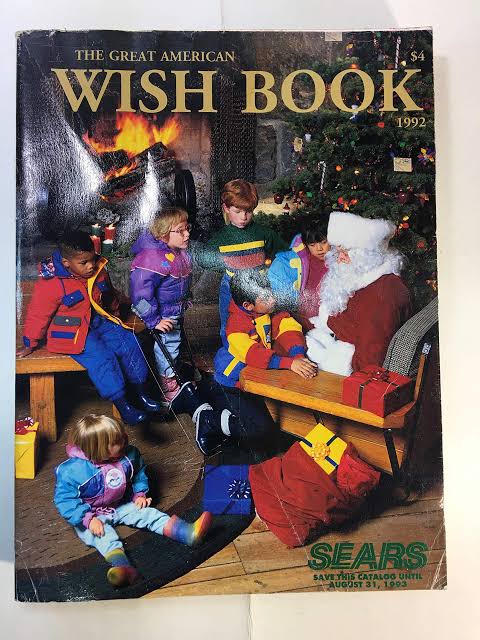
Remember the Sears Wish Book?
Oh my Goodness.
If you grew up in the ’70s, ’80s or ’90s, there’s a good chance you know EXACTLY what I’m talking about.
The Sears Wish Book.
For me, that catalogue was practically a Christmas tradition.
I spent HOURS flipping through it. Circling toys. Clothes. Art supplies.
Things I desperately wanted. Things I probably had absolutely no chance of getting.
It didn’t matter.
Dreaming was half the fun.
And somewhere in that experience, our parents were getting a pretty convenient shopping list.
It was genius.
Not because it was technologically advanced.
Because it understood how kids behaved and how families shopped.
And decades later, I can still remember how that catalogue made me feel.
That’s the power of emotional marketing.
How Does the Amazon Kids Gift Book Reach Two Different Audiences?
Here’s what I find particularly interesting about this approach.
It’s speaking to two audiences at once.
Audience One: Kids
For children, the catalogue creates a tangible, interactive experience.
They can explore products at their own pace, revisit favourite pages and show family members what catches their attention.
There’s something different about physically circling a toy compared with clicking a heart icon on a screen.
It feels personal. It’s an activity. And it creates an easy way to communicate gift ideas to the adults doing the shopping.
Audience Two: Gen X and Millennial Parents
This is where nostalgia comes in.
Many Boomers, Gen Xers and older millennials grew up with printed catalogues, holiday flyers and the Sears Wish Book.
Seeing a modern version can bring back memories of childhood excitement and Christmas traditions.
Suddenly, the catalogue isn’t just showing products.
It’s reminding adults of an experience they loved. And perhaps encouraging them to share something similar with their own children.
One marketing piece. Two audiences.
Two different emotional connections.
That’s knowing your WHO.
Of course, not every parent has those memories, and not every child will respond the same way. But the concept demonstrates how one format can appeal to different motivations within the same household.
Is Print Marketing Still Effective in a Digital World?
It certainly can be.
Digital marketing offers enormous advantages.
It’s flexible, measurable, fast and often highly targeted.
But print offers something different.
A physical presence. A tangible experience.
Something that can be held, displayed, shared or revisited without opening an app.
That doesn’t mean every business should rush out and print a catalogue.
Please don’t take that as the lesson.
The lesson is that the best marketing channel depends on the audience and the experience you’re trying to create.
For some businesses, that might be a beautifully designed direct-mail piece.
For others, a handwritten thank-you card.
A printed guide. A small booklet. A thoughtful gift.
Or a simple brochure that customers actually want to keep.
Print isn’t automatically better than digital. Digital isn’t automatically better than print.
The question is whether the format helps your message connect with the people you’re trying to reach.
Sound familiar?
Why Does Simple Marketing Sometimes Work Better?
Because complexity isn’t the same as effectiveness.
Businesses sometimes feel pressure to make every marketing campaign bigger, flashier and more technologically advanced.
More automation. More platforms. More content. More features.
And sometimes, those tools are exactly what a business needs.
But sometimes the smartest marketing idea is surprisingly simple.
It starts with understanding how your customers think, feel and behave.
What catches their attention?
What do they enjoy?
What makes them feel understood?
What would make their experience easier or more memorable?
Then you build something around those answers.
The brilliance of a kids’ gift catalogue isn’t the paper.
It’s the understanding of the people using it.
What Can Small Businesses Learn From Nostalgia Marketing?
You don’t need Amazon’s budget to create a meaningful emotional connection.
You need to understand your audience.
A local bakery might bring back a beloved childhood treat.
A family-owned retailer might share stories and photographs from its early years.
A service business might build a campaign around the familiar frustrations its customers experience.
A local toy store might create a holiday wish-list tradition that families look forward to every year.
The opportunity isn’t necessarily to recreate something old.
It’s to recognize the memories, traditions and emotions that matter to your customers and find an authentic way to connect with them.
And authenticity matters.
Nostalgia works best when it feels relevant to the brand and the people it serves, not when it’s simply pasted onto a campaign because retro graphics happen to be trendy.
What Does This Have to Do With Brand Strategy?
Everything.
The Amazon Kids Gift Book is a great reminder that effective marketing doesn’t begin with a format.
It begins with an understanding of people.
Who is the audience? What motivates them? What do they remember? What experience would make them engage? What makes the message personally relevant?
Those are brand strategy questions.
And they’re the same questions I encourage businesses to answer before investing in advertising.
When you know your WHO, you can make much smarter decisions about your WHAT and WHERE.
Which brings me back to another lesson I recently learned while travelling through Tokyo.
Sometimes the problem is too much advertising.
Sometimes the opportunity is something wonderfully simple.
Both come down to knowing your audience.
Frequently Asked Questions About Nostalgia Marketing
What is nostalgia marketing?
Nostalgia marketing is a strategy that uses familiar memories, traditions, imagery or experiences to create an emotional connection with an audience. Brands may reference past products, cultural moments or shared experiences to make their messaging feel more meaningful.
Why is nostalgia effective in advertising?
Nostalgia can evoke positive emotions, familiarity and personal memories. When those feelings align with a brand and its audience, they may help make an advertising message more engaging and memorable.
Does nostalgia marketing work for Gen X and millennials?
It can. Many Gen X and millennial consumers have strong memories associated with products, entertainment, technology and traditions from their childhood. However, effective nostalgia marketing depends on understanding the specific audience rather than assuming an entire generation shares the same experiences.
Is print marketing still worth using?
Print marketing can be valuable when it fits the audience, message and business objectives. Physical materials can create a tangible experience and complement digital marketing, particularly when they’re useful, memorable or designed to be kept.
How can a small business use nostalgia marketing?
Small businesses can draw on authentic local history, familiar traditions, past customer experiences, classic products or shared cultural memories. The goal is to create a relevant emotional connection rather than simply making something look old-fashioned.
Sometimes the Smartest Marketing Is the Simplest
I love technology.
I love what digital marketing makes possible.
I love the opportunities AI is creating for businesses.
But I also love being reminded that none of those tools replaces understanding people.
Sometimes a little paper catalogue can teach us more about meaningful marketing than another fancy digital campaign.
Because when you understand your audience, you can create experiences that connect.
And when people feel connected, they’re more likely to remember you.
That’s what I help businesses uncover through Greenlight Creative Marketing and my Brand A.M.P. Strategy Sessions.
Not just where to advertise.
But who you’re talking to, what makes your business different and how to communicate it in a way that actually matters.
Now, if you’ll excuse me, I have a sudden urge to find an old Sears Wish Book and start circling things.
Some habits never die.
Greenlight Creative Marketing
angie@greenlightcreativemarketing.com